
Blog
The Beauty of Giving Nature a Second Life: Benefits of Upcycling Natural Materials

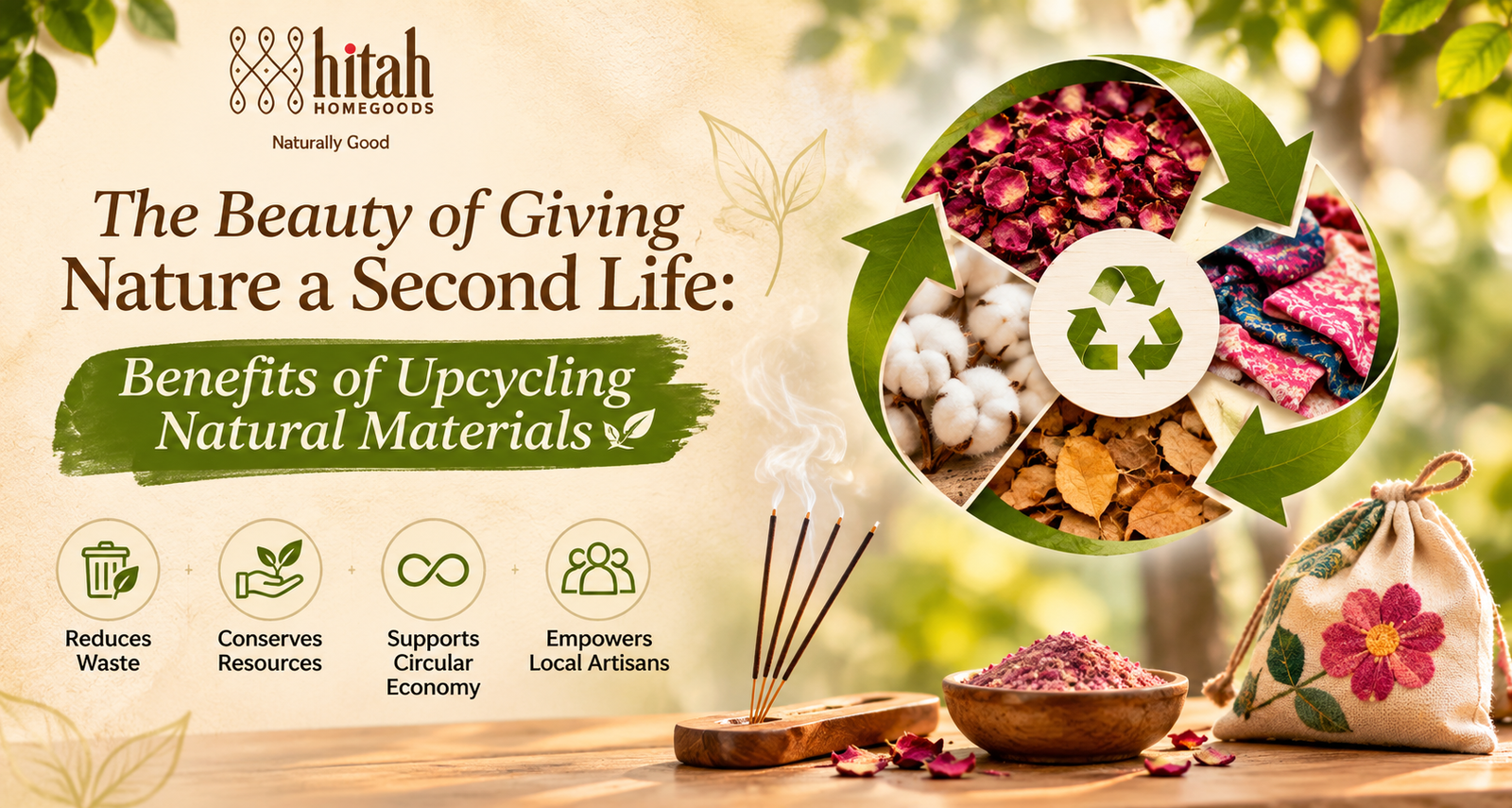
Discover how upcycling natural materials reduces waste, preserves resources, supports local artisans, and brings sustainable living into our everyday lives.
Nature Gives Generously. How Can We Give Back?
Every day, nature provides us with an extraordinary variety of materials—flowers, leaves, seeds, wood, cotton, and countless other resources that enrich our lives. Yet, many of these materials are discarded after serving their immediate purpose, even when they still hold value.
Think of the flowers used in celebrations, the fabric scraps left behind by tailors, or the fallen leaves collected from gardens. What if these seemingly unwanted materials could begin a new journey instead of ending up as waste?
This is the beauty of upcycling natural materials—transforming what might otherwise be discarded into something useful, meaningful, and beautiful.
Unlike recycling, which often involves breaking materials down to create something new, upcycling gives existing materials a second life with relatively little processing. It encourages us to look beyond an object’s original purpose and recognize its remaining potential.
At Hitah, this philosophy is reflected in our efforts to create useful products from thoughtfully repurposed materials while supporting skilled hands.
1. Reducing Waste Through Creative Reuse
One of the most important environmental benefits of upcycling is waste reduction.
Across homes, businesses, farms, and industries, enormous quantities of natural materials are discarded daily. While some biodegradable materials can decompose under suitable conditions, their disposal is not always managed responsibly.
Upcycling offers an alternative by putting usable materials back into circulation.
For example, flowers used in religious offerings, ceremonies, and celebrations are often discarded once the occasion is over. Although their fresh fragrance and appearance may fade, the dried petals can still be useful in certain products.
At Hitah, we use upcycled flower powder in our incense sticks, giving floral materials another purpose. Since dried flowers lose much of their original fragrance, essential oils are added to create the desired aroma.
This approach illustrates how floral waste upcycling can transform a discarded resource into an everyday product.
The principle is simple: before throwing something away, consider whether it can be used differently.
2. Conserving Nature’s Valuable Resources
Every new product requires resources. Raw materials must be obtained, processed, transported, and transformed before reaching consumers.
Upcycling can reduce the demand for certain new materials by using resources already available.
Consider the textile industry. Manufacturing fabric requires fibers, water, energy, and various processing steps. When perfectly usable fabric remnants are discarded, the resources invested in producing them are also wasted.
Turning these scraps into appliqué decorations, accessories, or other useful items helps extend their value.
Resource conservation through upcycling is particularly meaningful because it recognizes that materials have an environmental history long before they become finished products.
However, upcycling is not automatically more environmentally friendly in every situation. Its benefits depend on factors such as additional processing, transportation, energy consumption, and product durability.
Thoughtful upcycling seeks to minimize these impacts while making good use of existing resources.
3. Encouraging a Circular Economy
Our conventional consumption pattern often follows a straight line: take, make, use, and discard.
A circular economy offers a different way of thinking. It aims to keep products and materials useful for as long as practical, reducing unnecessary waste and dependence on newly extracted resources.
Upcycling is one way to support this approach.
Imagine a piece of cotton fabric. After being cut to make clothing, the leftover pieces need not become waste. They could be transformed into decorative appliqué, small pouches, or household accessories. Hitah is documenting use of tailor scraps.
The material continues to serve a purpose rather than immediately leaving the economic cycle.
This is particularly relevant to sustainable home goods, where everyday items can be designed with material efficiency and longevity in mind.
At Hitah, we believe that materials deserve thoughtful consideration, whether they are being used for the first time or given another life.
4. Supporting Local Artisans and Traditional Skills
The benefits of upcycling extend beyond the environment. They can also create opportunities for people.
Many upcycled products require imagination, careful handling, and skilled craftsmanship. Sorting materials, preparing them for reuse, developing designs, and producing finished goods all involve human effort.
These activities can support small-scale production and generate opportunities for artisans and local communities.
In Kanchipuram, Tamil Nadu, where Hitah has its manufacturing operations, craftsmanship is deeply connected to the region’s cultural identity.
At Hitah, we train and employ women from nearby villages, creating opportunities to develop practical skills and participate in production.
Through activities such as making incense and working with repurposed fabrics, materials that might otherwise be overlooked can become the foundation for useful products.
Sustainable handmade products therefore have the potential to represent more than resource conservation. They can also reflect the skills, dedication, and economic participation of the people who make them.
The hands that create a product are as important as the materials used.
5. Reducing the Pressure on Landfills and Waste Systems
Even natural materials can create disposal challenges when large quantities accumulate without proper waste management.
Organic waste decomposing in oxygen-poor landfill conditions can generate methane, a potent greenhouse gas. The extent of these emissions depends on the material and disposal conditions.
Responsible composting is an excellent option for many organic materials, as it returns nutrients to the soil. Upcycling provides another possibility when materials remain suitable for productive use.
For example, suitable flowers may be repurposed before their eventual disposal, while clean textile offcuts can be incorporated into new items.
By making better use of existing materials, eco-friendly upcycling practices can help reduce the amount of waste requiring disposal.
The goal is not to eliminate every discarded natural material. Rather, it is to choose the most appropriate destination for it—reuse, upcycling, composting, or responsible disposal.
Each option has its place in a more sustainable society.
6. Inspiring Creativity and Appreciation for Nature
Upcycling also changes the way we perceive ordinary things.
A dried seed may become a decorative element. A fallen branch may be shaped into a useful household object. Small fabric remnants may be arranged into a colorful design.
These transformations encourage creativity while reminding us that usefulness is not always immediately visible.
Natural materials have distinctive textures, shapes, and colors that are difficult to reproduce exactly. Their irregularities can become part of a product’s character.
This is one reason handmade products from natural materials often appeal to people seeking individuality and a closer connection with the natural world.
Creative reuse also encourages us to value the thought and effort behind an object rather than judging it only by its appearance or price.
A meaningful product need not begin with a newly purchased raw material.
Sometimes, creativity begins with what we already have.
7. Making Sustainable Living Part of Everyday Life
Sustainability can sometimes seem like an overwhelming responsibility. Environmental challenges are complex, and individual actions alone cannot resolve them.
Nevertheless, everyday choices can contribute to broader changes in consumption habits.
Sustainable living does not necessarily require dramatic lifestyle changes. It can begin with small, practical decisions:
- Reuse glass jars and containers instead of immediately discarding them.
- Choose reusable cotton bags for shopping.
- Repurpose clean fabric scraps for household projects.
- Compost suitable kitchen and garden waste.
- Repair useful belongings before replacing them.
- Support artisans and businesses that make responsible use of materials.
These habits encourage a shift from convenience-driven disposal toward thoughtful consumption.
They also help us recognize that sustainability is not simply about buying products labeled “green.” It is about considering how much we consume, how long we use what we own, and what happens when an item is no longer needed.
Conscious consumption begins with asking whether something can serve another purpose before it is discarded.
8. Upcycling Natural Materials: A Responsibility and an Opportunity
Nature works through cycles. Fallen leaves decompose and enrich the soil. Organic matter becomes nourishment for new growth. Resources continually move through interconnected systems.
Human-made products do not always follow these patterns.
Upcycling encourages us to reconsider the linear approach to consumption and explore ways to keep useful materials in circulation.
However, responsible upcycling also requires attention to safety and quality. Materials must be suitable for their intended purpose, properly cleaned or processed where necessary, and free from contamination that could make their reuse unsafe.
The best upcycled products combine environmental consideration with functionality, durability, and thoughtful design.
There is little benefit in making an object from discarded materials if it quickly becomes unusable.
The real value lies in creating something people can appreciate and use meaningfully.
Hitah: Creating Value from What Nature Has Already Given
At Hitah, we believe sustainability begins with respect—for nature’s resources, for the people who work with them, and for the communities in which we operate.
Our upcycled flower-based incense and products created using fabric remnants reflect our efforts to reduce unnecessary waste through purposeful design and skilled craftsmanship.
We recognize that building a responsible business is an ongoing process involving thoughtful choices, continuous improvement, and accountability.
For us, upcycling natural materials is not merely a production technique. It is a way of recognizing value where it might otherwise be forgotten.
Every flower, every piece of fabric, and every natural resource have a story. With imagination and care, some of those stories can continue.
When we give nature’s materials a second life, we also give ourselves an opportunity to live more thoughtfully.
Hitah — Naturally Good.